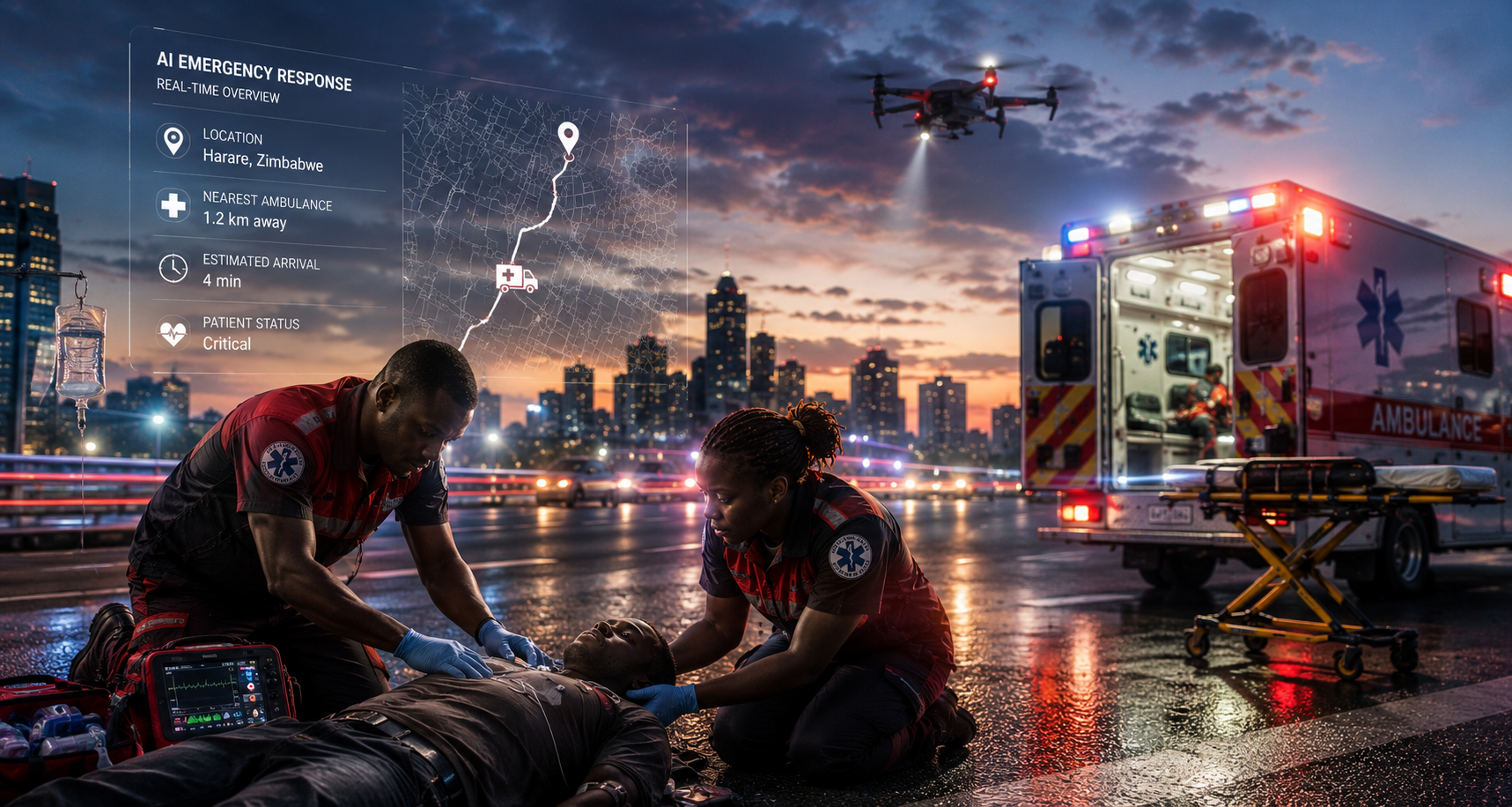
Every second counts.
AI-powered emergency healthcare.
LifeLine+ connects patients, hospitals, and ambulances using artificial intelligence to reduce emergency response times and improve patient outcomes.
From distress to dispatch in seconds
Three coordinated steps, powered by AI and connected to the network.
Request help
Press the SOS button. Share symptoms with the AI in English, Shona or Ndebele.
AI triage
The assistant assesses severity, gives first aid, and generates a hospital handoff.
Coordinated response
The nearest suitable hospital is notified and the ambulance is dispatched with your report.
A complete emergency care platform
AI Emergency Assistant
Conversational triage in English, Shona and Ndebele.
Live Ambulance Tracking
Real-time ETA and route updates from dispatch to arrival.
Smart Hospital Matching
Chosen by distance, specialty, and current bed availability.
Secure Medical Records
Blood type, allergies and history shared only when needed.
Multi-channel Alerts
In-app, SMS and voice channels for care coordination.
Health Analytics
National-scale insights for public health authorities.
Built for everyone in the emergency chain
For patients
Faster help, in your language, with the hospital that fits your case.
For hospitals
Structured handoff reports arrive before the patient does.
For ambulances
AI-prioritized queues and turn-by-turn navigation.
For authorities
National dashboards and disease trend analytics.
Triage that thinks like a clinician.
Our AI is trained to ask the right questions, weigh red flags, and produce a structured handoff. It works alongside human dispatchers, not instead of them.
- Severity classification (Low → Critical)
- First-aid instructions while help is on the way
- Structured hospital handoff (vitals, allergies, timeline)
- Multi-lingual: English · Shona · Ndebele
- Predictive analytics for outbreak signals
Why AI, and not just a form?
LifeLine+ is submitted under the AI4I Development track. The Challenge explicitly penalises 'AI as a label'. This page documents where AI is doing real work and where simpler logic is deliberately used instead.
A patient can upload a photo of a wound or a short video. A rules engine cannot judge if a burn is second- or third-degree; Gemini vision can, and it feeds that observation into the severity score.
Patients describe symptoms in English, Shona and Ndebele, often mixing languages. Keyword matching misses 'inhliziyo iyaphimisela' but the model reads intent, negation and colloquialisms.
Hospitals receive a clinical summary, red flags and recommended specialty in English, generated from the patient's local-language description. That translation-plus-summarisation task is what LLMs do best.
How the AI pipeline works
The patient describes symptoms by text or voice, selects tags, and optionally uploads photos or video.
Vision layers describe wounds, rashes, swelling or breathing effort from the uploaded media.
The model weighs red flags, pain level, age and history against a clinical severity rubric.
A SQL query ranks hospitals by distance, specialty and beds. AI does not replace this step.
A structured report is generated for the receiving hospital: severity, red flags, first aid given, allergies and recommended specialty.
Rules-only vs LifeLine+ (side by side)
| Task | Rules / SQL baseline | LifeLine+ with AI |
|---|---|---|
| Assess a wound from a photo | Impossible - no visual understanding. | Gemini vision reads bleeding, swelling, depth and colour into the severity score. |
| Understand Shona/Ndebele free text | Requires per-phrase keyword lists that break on typos or code-switching. | Handles negation, mixed languages and colloquialisms out of the box. |
| Generate a clinical hospital handoff | Templated string with slot-filling - no reasoning about what the ED needs to know. | Structured English report with red flags and specialty, ready for the receiving team. |
| Real-time first-aid guidance | Static decision tree, hard to keep current across every symptom combination. | Instructions tailored to the exact reported symptoms and history in the patient's language. |
Google Gemini 3.6 Flash via the Lovable AI Gateway. Chosen for native vision, sub-2s latency and multilingual coverage of Bantu languages.
Under 2 seconds for text triage; under 6 seconds for multimodal assessment with one image.
Only the current SOS payload: selected symptom tags, free-text description, pain score, age, optional photos/video frames. No training on patient data, no PII shared beyond the active request.
Temperature 0.3 with a strict Zod JSON schema to constrain output and reduce hallucination.
Safety & guardrails
AI recommends; dispatchers and hospital staff decide. The handoff is a decision-support document, not a diagnosis.
Critical cases are flagged immediately and bypass the queue so they reach the nearest capable hospital first.
Every model response is validated against a typed Zod schema before it reaches the patient or hospital UI.
If the AI Gateway is unreachable, a deterministic rule-based triage runs on-device so the patient is never left without guidance.
What happens when the AI is unreachable?
If the network drops or the AI Gateway is rate-limited, LifeLine+ falls back to a deterministic, on-device rule-based triage. The result is clearly labelled as offline triage, and hospital staff re-assess on arrival. The app keeps working even when connectivity does not.
Connected to Zimbabwe's leading emergency centres
Trusted across the emergency chain
"The AI handoff report saves us critical minutes. Patients arrive with context already documented."
"When my father collapsed, LifeLine+ dispatched an ambulance and matched us with the right hospital in minutes."
"AI-prioritized calls mean I know exactly what to prepare for on the way."
Frequently asked questions
Is LifeLine+ available across Zimbabwe?
We are onboarding hospitals city by city. Today we cover Harare, Bulawayo, Mutare, Gweru, Masvingo and Victoria Falls with more coming.
Does the AI replace medical professionals?
No. The AI supports dispatchers and hospital staff with faster triage and structured handoffs. All care decisions remain human.
How is my data protected?
Records are encrypted, access is scoped by role, and you control what is shared during an emergency.
Which languages are supported?
English, Shona (chiShona) and Ndebele (isiNdebele).
Do I need a smartphone?
LifeLine+ works on any modern browser, and we support SMS fallback for low-bandwidth areas.